Looking for engaging, creative activities to spark your child’s curiosity and inspire their learning?
We believe equipping your child with a skill that will enrich their life forever is profoundly impactful.

Founder of EyeMagine Zone
and the playful mind behind Little Lens Explorers.
and the playful mind behind Little Lens Explorers.
Renee Howard
For over six years, I’ve captured the world through my lens—earning multiple magazine features, prestigious photography awards, and a reputation for creating magic in every frame. My specialty? Working with “the littles”—those big-eyed, endlessly curious kids who see the world with wonder.
This course was born from a personal mission: to do something bigger than myself and plant seeds of creativity in young minds while they’re still shaping their view of the world. I know firsthand the power of encouragement—Now, I’m here to be that person for the next generation, empowering kids to explore, imagine, and create fearlessly.
Exactly what are the benefits?
Key Benefits:
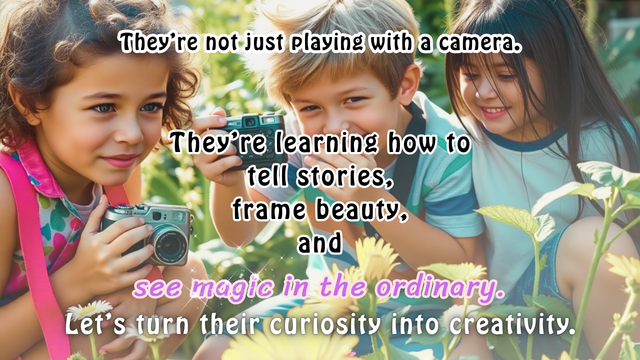
Research suggests photography can boost creativity and observation skills in young children.
Photography has been proven to help with social and emotional development, like self-expression and confidence.
The evidence leans toward photography supporting cognitive growth, such as problem-solving and memory skills.
Studies show it can enhance engagement in learning and provide a voice for children to share their perspectives.
Detailed Findings from Studies:
Empowerment and Self-Expression
- Study Reference: "Snap: young children share the importance of relationships through child-led photography" (Early Years, 2023, Vol. 43, No. 3).
- Details: This study involved 20 children aged 3-4 from two Australian preschools, who took a total of 417 photos using disposable cameras. It found that photography empowered children by giving them a voice and a means of self-expression, allowing them to share their unique perspectives. The photos revealed themes such as child-child interactions, child-nature connections, and child-adult relationships, highlighting the importance of relationships in their lives.
- Impact: Photography acted as a vehicle for children to exercise agency, deregulate decisions, and express desires, such as photographing "out of bounds" areas via shadows (e.g., 12 shadow photos by Matt, Alice, and Phillipe). This empowerment was particularly evident in children asking for second cameras, indicating high engagement.

Participatory Learning and Engagement
- Study Reference: Same as above, with additional insights from "Picture This: Using Photography as a Learning Tool in Early Childhood Classrooms" (Childhood Education, 2009, Vol. 85, No. 4).
- Details: The participatory approach involved children as active co-researchers, selecting subjects and capturing images that reflected their ideas. The 2023 study noted children expressing excitement, with one child, Max, stating, “I like [the researcher] because she bought us the cameras.” The 2009 study emphasized photography as a tool for enabling young children (aged 2-4) to share thoughts about their environment, enhancing engagement.
- Impact: This approach made learning enjoyable and meaningful, sparking curiosity and enthusiasm, which is crucial for early education settings.
Insight into Children's Perspectives
- Study Reference: "Snap: young children share the importance of relationships through child-led photography" (2023).
- Details: The photographs provided visual narratives of children's emotions and experiences, with four common themes emerging: child–outdoor place, child–child, child–nature, and child–adult. Conversations with all 20 children were video recorded and transcribed, revealing incomplete stories without dialogue, underscoring the need for collaborative interpretation.
- Impact: This method offered educators and researchers deeper insights into children's priorities, such as the importance of relationships, enhancing understanding of their inner worlds.
So.......
what are you waiting for?

Stay Connected
Got Questions? Contact Us!
Copyright © Kismet Entities LLC 2026
Created with